Modular healthcare buildings support patient care by providing customizable facilities designed to meet specific medical needs. Builders can quickly set up these facilities, allowing healthcare providers to respond quickly to urgent demands. Enhancing patient care access with portable healthcare buildings involves the following:
Capacity Expansion
Portable healthcare buildings support capacity expansion by providing an effective way to add spaces such as exam rooms and waiting areas. Their modular design allows for capacity expansion through the following elements:
- Ease of attachment
- Stand-alone facilities
- Time efficiency
Modular units facilitate expansion through their design for scalability and seamless integration. The construction process leverages standardized components and off-site manufacturing to allow additional units to be added with minimal disruption. The modules are built to precise specifications in a factory setting, allowing them to attach to existing traditional structures easily. Linking the units to existing structures helps integrate the new space with the current facility footprint.
The on-site assembly is highly streamlined, reducing noise and dust that might impede the functioning of a healthcare facility. Units may function entirely on their own, creating new points of access to care. They can add space without remodeling a building.
Remote Area Access
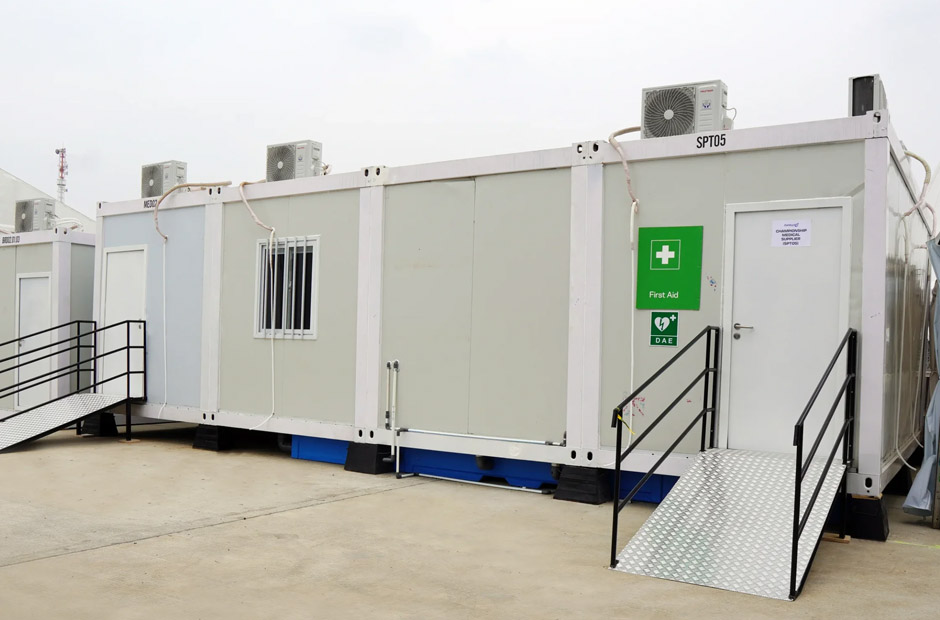
Professionals can set up portable healthcare clinics at remote locations using modular buildings. These facilities allow patients in remote areas to receive medical care at local branches without travelling to central population hubs. The clinics can be configured as complete self-sufficient facilities to include offices and bathrooms. Experts supply full turnkey solutions, such as water storage systems and generators for power in off-grid areas.
The mobility of portable healthcare clinics allows for quick and efficient transport and setup in locations where permanent construction is not feasible. Each modular unit’s physical design allows it to be transported via trucks or rail, facilitating clinic placement where the need is greatest. Facilities are not dependent on a specific pre-developed piece of land with existing infrastructure.
Customization Potential
Professionals customize healthcare buildings to provide targeted care and optimal functional layouts. Customization allows facilities to be purpose-built for specific services like diagnostics, specialized consultations, and emergency response. The integration of specialized equipment and technology allows for services like X-ray imaging and testing in fully functional medical laboratories. Builders can design the facilities as dental clinics or physical therapy centers. During crises, units can specifically be configured for triage or as vaccination hubs.
Experts create custom designs to optimize patient flow and minimize wait times. Properly designed examination rooms, secure record storage areas, and comfortable waiting spaces contribute to a more efficient standard of care delivery. Customization includes the integration of health information technology to offer more diagnostic and treatment options. Through customization, these units can be flexible to serve multiple purposes with changing circumstances.
Structural Integrity
Modular health care clinics are constructed to be sturdy and reliable for long-term service. Builders follow standardized processes to create high-quality and safe structures. They use quality materials, such as steel and concrete, and perform inspections during manufacturing. When designing modular units, engineers assess the unique requirements of healthcare operations. They design the structures with sufficient strength to support heavy medical equipment needed for diagnostic services. Manufacturing in a controlled factory environment allows for quality checks at every stage to minimize defects.
Portable health care clinics can remain operational during extreme weather events and natural disasters. Engineers design them to withstand the specific conditions of their locations, such as resilience to seismic activity or strong winds. By withstanding environmental challenges, the structural integrity of portable clinics promotes the continuity of patient care access.
Speedy Construction
The speed and efficiency of the modular construction process translate to faster delivery of medical services when and where needed. In situations like a pandemic, rapid deployment allows healthcare providers to establish emergency care centers without delay. Modular facilities can be operational in a fraction of the time compared to traditional construction methods. On-site work and building manufacturing off-site happen simultaneously to shorten the project timeline. The speed helps quickly establish healthcare access in underserved areas that currently have limited or no facilities.
Reliable Portable Healthcare Buildings
Premium healthcare providers such as Optum Oregon can use modular clinics to test the viability of a new service line or physical location in a community. These facilities bridge the gap between immediate demand and the completion of permanent facilities, preventing care accessibility lapse during construction. Contact a reputable building systems provider to learn more about what they offer.