Large-scale prefabricated projects place very different demands on manufacturers than single-building requirements. A prefabricated building company working on multi-building or international developments needs to manage more than unit production. Engineering, material consistency, delivery sequencing, and site requirements all become part of the same project framework.
This is especially important for construction, infrastructure, and industrial sites where several building functions may need to be delivered within a coordinated program.
Manufacturing Structure Matters from the Beginning
A prefabricated project starts well before the first unit reaches the site.
Structural systems, wall panels, insulation, openings, and internal specifications need to be translated into a repeatable production process. As the project grows, maintaining the same technical standards across multiple buildings becomes more demanding.
A standalone office can be produced as an individual structure. A larger development may require accommodation buildings, offices, sanitary units, canteens, locker rooms, technical spaces, and storage areas within the same scope.
For this reason, production capability should be evaluated together with engineering organization and quality control. A broad catalog alone does not show whether a manufacturer can manage repeated production under a single technical specification.
Engineering Should Reflect the Destination
Prefabricated buildings still need to respond to the conditions of the location where they will be installed.
Climate, insulation requirements, structural criteria, electrical systems, internal layouts and intended use can vary considerably between markets. These factors are most efficiently addressed before manufacturing begins.
Manufacturers with experience across different markets can incorporate destination-specific requirements earlier in engineering and production planning. This reduces the risk of late revisions and helps keep technical decisions aligned with the manufacturing schedule.
International experience is therefore relevant not because every project follows the same model, but because different destinations can require different technical and logistical solutions.
Multi-Building Projects Add a Different Level of Complexity
Multi-building projects create challenges that do not exist at the same scale in individual orders. Different building types may still need to follow the same structural, material, and delivery framework.
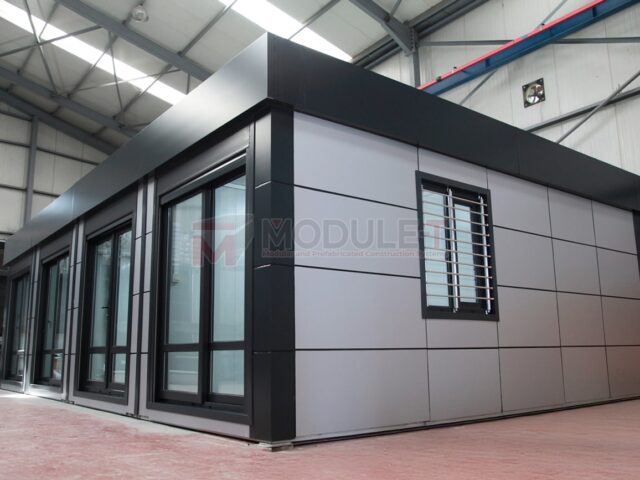
For Module-T, this type of coordination is part of the company’s work on large-scale overseas projects. Its production model is structured around handling different building functions within the same project scope, from accommodation and office units to sanitary, dining and support facilities. This allows technical specifications, manufacturing sequence, and delivery priorities to be planned together instead of treating each structure as an isolated order.
That approach becomes especially relevant when repeated units and different building types need to move through production at the same time. Standardized manufacturing procedures can help maintain consistent structural, insulation, and finishing specifications across the wider project.
Logistics Should Be Defined Early
International prefabricated projects are shaped by transport requirements as much as by building specifications.
Building dimensions, packaging, delivery sequence, site access and installation planning can influence engineering decisions before production is complete. Leaving these issues until the end can create unnecessary complications at the destination.
Delivery sequencing becomes particularly important on large sites. Buildings needed during mobilization may have to arrive before accommodation or operational facilities planned for later stages.
When this sequence is defined early, manufacturing and logistics can follow the actual construction program rather than treating every building as an independent delivery.
This is especially useful for remote project locations where temporary storage, lifting equipment, or local installation resources may be limited.
Customisation Needs Clear Limits
Prefabricated construction benefits from repeatable production, but projects rarely require completely identical buildings.
Layouts, room divisions, insulation specifications, doors, windows and internal installations can be adapted according to operational needs. The challenge is to manage these changes without creating unnecessary variation across the project.
A clear technical scope helps define which elements should remain standard and which require project-specific adaptation.
This is particularly important when several units are produced under the same contract. Early decisions make procurement easier, simplify manufacturing sequences and improve consistency between buildings.
Supplier Structure Can Affect the Wider Project Programme
For large-scale developments, the selection of a prefabricated building supplier should go beyond comparing the price of individual units.
The manufacturer’s production organization, engineering capability, experience with multiple building types and ability to coordinate international delivery can influence the wider project schedule.
This matters because site offices, workforce facilities and operational buildings are often required before other project activities can progress efficiently. A delay in these supporting structures can create pressure elsewhere in the program.
The strongest procurement approach is therefore to evaluate how the manufacturer manages the complete process rather than focusing only on the finished building.
For international and multi-building projects, consistent production, early engineering decisions and coordinated logistics provide a more controlled route from technical specification to final installation.