Key Takeaways
- SSD performance and durability are determined by a range of technical and environmental factors that should be considered when selecting or maintaining storage devices.
- Certain SSD features, such as robust wear leveling and quality firmware, are essential for maximizing lifespan and data integrity.
- Proactive care, monitoring, and selecting SSDs tailored to your operational needs can help prevent premature failure.
Solid State Drives (SSDs) have dramatically enhanced the speed, efficiency, and resilience of data storage for personal and enterprise applications. Yet multiple technical and environmental variables play key roles in how well an SSD performs over time and in its overall life expectancy. Discerning users must weigh these factors to ensure their SSD storage solutions are both fast and reliable. If you are looking to optimize your SSD’s longevity, understanding aspects such as NAND flash type, write amplification, and thermal management is a critical first step. With these insights, you can take proactive measures to minimize risks and maximize data integrity, while becoming familiar with essential terms such as DWPD, which measures endurance for enterprise drives.
While SSDs are resistant to many physical failures that affect traditional hard disk drives, they are not immune to wear and environmental risks. This is why the right balance of high-performance technology and maintenance is crucial. Early signs of degradation can often be mitigated by managing operating temperatures, making timely firmware updates, and ensuring robust error correction. Together, these steps prevent issues that can lead to sudden data loss or drive failure.
The importance of selecting SSDs geared for your specific workload cannot be overstated. Enterprise and consumer disks use different technologies, each tailored to different read/write frequencies and data protection requirements. SSD health is dependent not just on raw performance but also on optimizing for the environment in which the drive operates, from data centers to portable devices.
This article unpacks the key factors influencing SSD performance and lifespan, empowering you to make evidence-based storage decisions tailored to your unique requirements.
NAND Flash Memory Type
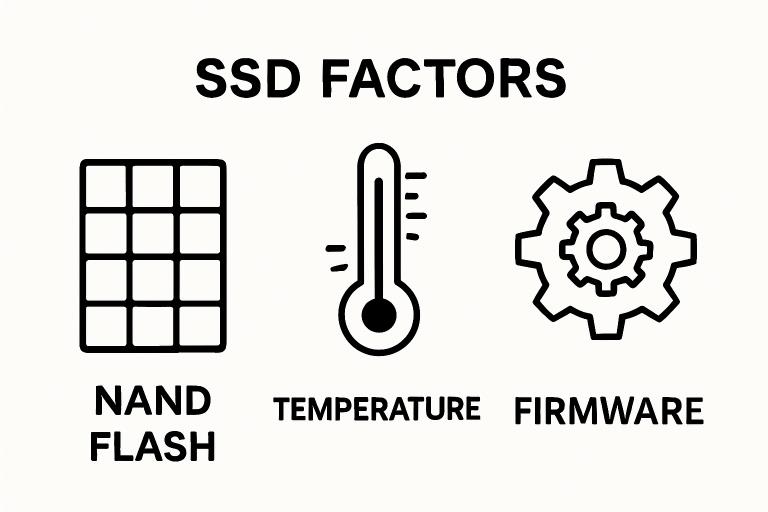
NAND flash memory forms the cornerstone of all SSDs, but not all NAND is created equal. The four predominant types are Single-Level Cell (SLC), Multi-Level Cell (MLC), Triple-Level Cell (TLC), and Quad-Level Cell (QLC). SLC is prized for high endurance and speed—ideal for caching and demanding enterprise applications. MLC and TLC variants provide a balance of capacity and cost, but store more bits per cell, thereby decreasing individual-cell endurance. QLC maximizes capacity and lowers cost still further, though its endurance is best suited for read-heavy or archival workloads. Selecting the right NAND type depends on use cases, planned workload, and budget constraints, underscoring why product comparisons and technical specifications are essential reading for IT decision-makers.
Write Amplification
Write amplification occurs when SSDs must write more data to their NAND flash than the computer system originally sent. This typically happens because SSDs must erase large blocks before rewriting, even for small updates, leading to more frequent wear. High write amplification increases stress on the storage cells, reducing the practical lifespan of a drive. Mitigating strategies, such as over-provisioning or advanced garbage collection techniques, minimize unnecessary write operations and distribute them more evenly, thereby protecting your drive’s longevity.
Wear Leveling
Wear leveling is a critical SSD technology that evens out wear across all memory cells. Without wear leveling, specific cells undergo excessive program/erase cycles, leading to premature failures. Algorithms embedded in SSD firmware carefully monitor and distribute writes to avoid overusing any one cell. Wear leveling extends drive life and is especially vital for drives that are frequently written to, as in databases or logging applications. Products specifically designed for write-intensive tasks will typically offer more advanced wear leveling, an important consideration in high-demand environments.
Temperature Management
The physical environment in which an SSD operates directly affects its speed, reliability, and lifespan. Heat, in particular, accelerates cell degradation, potentially leading to performance throttling or permanent data loss. Effective cooling solutions, such as heat sinks or improved system ventilation, keep SSDs within optimal temperature ranges even under heavy workloads. Proper thermal management not only safeguards the drive but also ensures you achieve consistent peak performance during intensive operations.
Firmware Quality
Firmware, the onboard software controlling SSD behavior, has a profound impact on performance, data security, and error handling. High-caliber firmware ensures data writes and reads are handled optimally, while actively correcting errors and managing drive health. On the flip side, poorly programmed or outdated firmware can introduce bugs, data integrity issues, or even total drive failure. Regular updates and choosing SSDs from established vendors go a long way toward reducing risk, as these manufacturers typically respond more quickly to emerging vulnerabilities and performance optimizations.
Power Loss Protection
One of the most potentially damaging events to data stored on SSDs is sudden power loss. Drives that lack robust power-loss protection are at greater risk of data corruption if they shut down unexpectedly. Some enterprise models feature capacitors and other hardware features to ensure data in transit is safely flushed to non-volatile storage. This is especially important for business-critical or always-on systems where even a brief interruption can have significant consequences.
Environmental Factors
Though less susceptible to shocks or vibration than traditional spinning hard drives, SSDs can still suffer in extreme conditions. High humidity, constant vibration, and very high or low temperatures can all degrade performance or precipitate failures. When deploying SSDs in industrial, automotive, or mobile applications, always consult the product’s environmental specifications and take appropriate precautions to ensure reliability and data safety.
Conclusion
A well-chosen and carefully maintained SSD can offer years of robust, high-speed storage. By understanding and addressing factors such as NAND flash type, write amplification, wear leveling, temperature management, firmware quality, power loss protection, and environmental impact, you are positioned to make smarter decisions about your data infrastructure, reducing risk and maximizing value for both personal and business use.