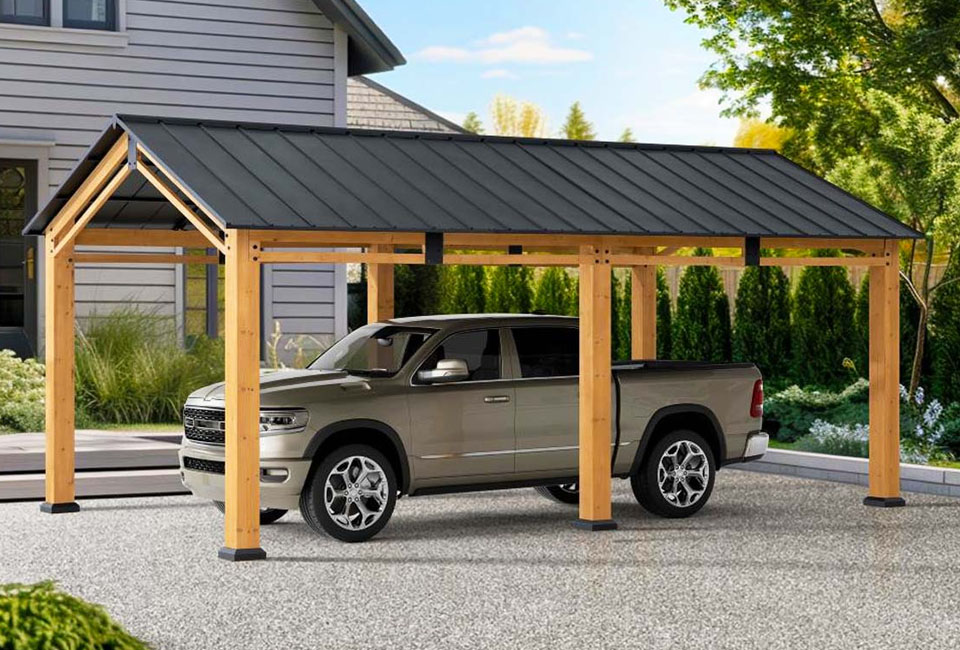
As homeowners and property investors rethink how they protect their vehicles and maximize their space, metal carports are becoming a surprisingly popular alternative to traditional wood or stick-built garages. In 2025, the shift is not just aesthetic; it’s rooted in hard-nosed economics, durability, and long-term value. Below, we explore why metal carports are quietly taking market share from conventional garages, examining build cost, construction time, resale impact, and insurance advantages.
1. Lower Build Cost: Metal Wins Big Upfront
One of the most compelling reasons for the rise in metal carports is their significantly lower construction cost. Prefabricated steel carport or garage kits generally cost between $10–$25 per square foot for materials, compared to $30–$70 per square foot for stick-built wood garages. For pure carport structures, the difference is even starker: a traditional wooden single-car garage might cost from $10,500 to $20,400, while a basic single-car metal carport can cost $2,400 to $8,400.
This large gap arises because metal buildings are often prefabricated in controlled factory environments: panels are cut precisely, less raw material is wasted, and on-site labor is lighter than traditional wood-frame construction.
2. Faster Build Times
Speed of construction is another major factor in metal carports’ growing popularity. Metal carports and garages, being prefabricated, can often be installed in 1 to 3 days, depending on size and crew. By contrast, a wood (stick-built) garage typically requires one to two weeks of on-site work.
The faster build time comes from pre-cut and pre-drilled components, more straightforward assembly, and lighter labor requirements. Metal buildings may also require simpler foundations: a level gravel pad or basic concrete slab is often sufficient, whereas wooden garages usually demand more substantial footings, adding time and cost.
3. Total Cost of Ownership and Maintenance
The financial advantages of metal don’t stop at construction. Over the life of the structure, maintenance savings are dramatic. Annual maintenance for metal garages typically accounts for just 1% of the initial cost, compared to 2–4% per year for wood structures.
Metal resists common issues that plague wood, such as warping, rot, termite damage, and the need for frequent painting or sealing. Over 20 years, metal carports may cost only $50–$100 annually in upkeep for basic models. In contrast, wood carports can rack up maintenance costs in the thousands. Even though a metal carport may cost $4,000 upfront, its 20-year maintenance cost might hover around $1,100, making it far more economical over its lifecycle.
4. Insurance Savings
Insurance is often overlooked in the decision-making process, yet metal carports offer a significant edge. Insurance premiums for metal building systems are typically around 15% lower than for wood equivalents. Over a decade, this could translate into substantial savings on building insurance.
The savings stem from metal’s fire resistance and structural durability. Steel is classified as noncombustible, does not warp or rot, and is impervious to pests. These characteristics reduce insurers’ risk and lower homeowners’ premiums.
5. Durability, Lifespan & Resale
Durability is another major factor behind the rise of metal carports. Metal buildings are more resistant to fire, rot, pests, and weather-related damage such as wind or snow loads. A steel garage or building can have a lifespan of 30–50+ years with minimal maintenance, while a wood garage may last 15–30 years, depending on upkeep.
In terms of resale value, steel garages retain 60–70% of their original investment after a decade, compared to 50–60% for wood structures. Even if carports do not add as much resale value as fully enclosed garages, a well-built metal carport boosts property appeal and provides durable, long-term utility. Additionally, metal structures are modular and easier to repurpose, such as converting part of a carport into a shed, workshop, or enclosed storage space.
6. Environmental and Safety Advantages
Beyond financial considerations, metal carports are gaining favor for their sustainability and safety. Steel is highly recyclable. Because it does not rot or degrade like wood, it generates less waste over time.
Fire safety is another advantage: metal is much less flammable than wood. Pest resistance is also significant, as metal structures do not attract termites or wood-boring insects. These qualities make metal carports cost-effective, resilient, and environmentally responsible.
7. Customization and Versatility
Modern metal carports are highly customizable. They come in various roof styles, including A-frame, vertical, and round-top, and can be painted in multiple colors. Homeowners often add walls, doors, and insulation to convert carports into workshops or enclosed buildings. Modular construction makes modifications or expansions much cheaper than with wood, allowing the structure to adapt to future needs.
8. Why 2025 Is Seeing a Shift
Several trends in 2025 are driving more people toward metal carports:
- Rising Lumber Costs & Volatile Wood Markets:Lumber prices remain unpredictable, increasing the cost of wood construction. Steel costs are more stable.
- Demand for Low-Maintenance Solutions:Busy homeowners and property investors want structures that require minimal upkeep.
- Insurance Incentives:Discounts for noncombustible metal buildings reduce the total cost of ownership.
- Real Estate Trends:Buyers increasingly value durability and functionality over traditional aesthetics.
- Sustainability Awareness:Recyclability and durability of steel appeal to environmentally conscious homeowners.
Conclusion
In 2025, metal carports are quietly taking market share from traditional wood garages, and the reasons are clear. Between lower upfront costs, faster build times, long-term savings, insurance incentives, and strong durability, metal offers an exceptional value proposition.
While wood garages retain charm and appeal in some neighborhoods, most homeowners who prioritize practical value, low maintenance, and long-term resilience are increasingly turning to metal. For anyone considering a vehicle shelter or outbuilding, metal carports provide a future-proof solution that combines affordability, versatility, and lasting quality.