Key Takeaways
- DC fast charging delivers power rapidly, enabling EVs to recharge much faster than with traditional charging methods.
- Technological advancements and expanded networks are making long-distance EV travel more practical.
- Government funding and industry standardization are accelerating nationwide infrastructure deployment.
- The future of electric vehicle mobility depends on efficient, accessible, and reliable fast-charging solutions.
Electric vehicles are rapidly transforming the global transportation landscape, offering consumers an eco-friendly choice while reducing greenhouse gas emissions. The pace at which EVs are being adopted, however, is directly influenced by how quickly, easily, and conveniently it is to recharge on the move. For many drivers, the answer lies in DC fast charger solutions that deliver a remarkable boost in charging speed compared to conventional AC options.
DC fast charging technology enables EV owners to gain miles of range in mere minutes, dramatically cutting down waiting times—an essential factor for widespread electric mobility. These high-powered stations have paved the way for longer, less stressful journeys and greater consumer confidence in electric vehicles. As the EV ecosystem continues to grow, robust DC fast-charging networks are proving vital for meeting surging demand and enabling rapid road trips.
EV infrastructure providers, automakers, and governments are investing heavily in future-proof charging corridors to ensure connectivity from urban centers to distant highways. This momentum is transforming not just how we fuel our vehicles, but how we envision the future of transport itself.
The rapid evolution of charging hardware and software, along with collaborative efforts from key industry stakeholders, is resolving longstanding range anxiety. Reliable, widely available DC charging promises to make electric vehicles mainstream for commuters, families, and fleet operators alike.
Understanding DC Fast Charging
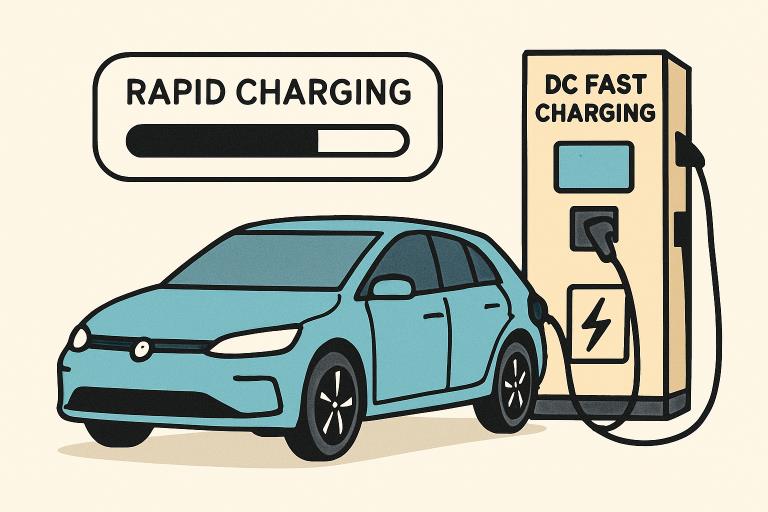
DC fast charging represents a significant advancement over the more familiar Level 2 chargers used in homes and workplaces. Whereas Level 2 equipment provides a consistent but moderate charge by relying on the vehicle’s onboard AC converter, DC fast chargers deliver high-voltage direct current straight to the battery, eliminating that conversion step. This direct power delivery dramatically accelerates charging speeds, often replenishing up to 80% of a battery’s capacity in roughly 15 to 30 minutes, depending on the charger’s output and the vehicle’s architecture. For drivers planning longer trips or those who rely heavily on their vehicles each day, this speed is essential.
Although plugging in overnight at home remains the most convenient and cost-effective option for everyday needs, rapid charging along highways and at popular destinations fills a different role. These public stations are designed to mirror the quick refueling experience people expect from traditional gas stations, helping reduce range anxiety and supporting more spontaneous, long-distance travel. Tools like the Alternative Fuels Data Center’s station locator make it easier for drivers to find these fast chargers in real time.
To meet growing demand, DC fast-charging sites are strategically placed in high-traffic areas, such as major travel corridors, shopping centers, and highway rest stops. Their presence ensures that both long-distance travelers and high-mileage urban drivers have reliable access to the rapid charging infrastructure needed to keep EVs moving throughout the day.
Advancements in DC Fast Charging Technology
Breakthroughs in hardware and software are shaping the next generation of fast chargers:
- Higher Power Capacities:Leading fast chargers now boast outputs exceeding 350 kW, with new models experimenting with even greater power delivery. This advancement significantly cuts wait times for drivers who need to top up their battery mid-journey. According to, ultra-fast chargers could soon offer 200 miles of range in about 10 minutes of charging, rivaling the convenience of traditional fuel stops.
- Superior Thermal Management:The heat generated by these massive energy transfers is mitigated by advanced cooling systems built into the charge cables and connectors, preserving battery integrity and keeping users safe.
- Smart Connectivity:Real-time monitoring and remote diagnostics now allow for robust uptime, predictive maintenance, and tailored user authentication experiences, linking charging services with vehicle navigation systems and mobile apps.
Expansion of Charging Networks
Widespread charging infrastructure is key to converting public curiosity into EV confidence. Leading providers like Electrify America have installed extensive DC charging corridors nationwide, including more than 950 locations and thousands of fast-charging connectors as of 2024. These accessible points reduce wait times, making electric cars viable for millions of drivers on the go.
Automaker collaborations have led to initiatives such as IONNA, a joint venture aiming to deploy 30,000 high-powered charging locations by 2030, dramatically expanding access to reliable public fast charging.
Government Initiatives and Support
Federal agencies recognize that public-private cooperation is fundamental to creating an interconnected charging ecosystem. In 2024, over $500 million in grants were earmarked to support the installation of more than 9,200 new EV charging ports, placing efficient charging within reach of diverse communities across the U.S. Such funding helps level the playing field, offering convenience to both urban and rural drivers, and powers progress toward ambitious net-zero carbon targets.
Future Outlook
The evolution of DC fast charging is set to reshape how Americans perceive and use electric vehicles. Market studies anticipate that the number of public DC fast charging ports will reach nearly half a million by 2040, generating billions in economic value. As EVs become the norm, readily available rapid charging will play a decisive role in decarbonizing travel, fostering innovation, and paving the way for next-generation autonomous and connected vehicle platforms.
Conclusion
DC fast charging stands at the frontier of the electric mobility revolution, bridging gaps in convenience and performance while removing barriers to EV adoption. With ongoing advancements in technology, greater network reach, government support, and unified charging standards, electric travel is becoming a universal reality. As the momentum builds, these systems are empowering drivers to embrace a cleaner, faster, and more accessible future on the road.