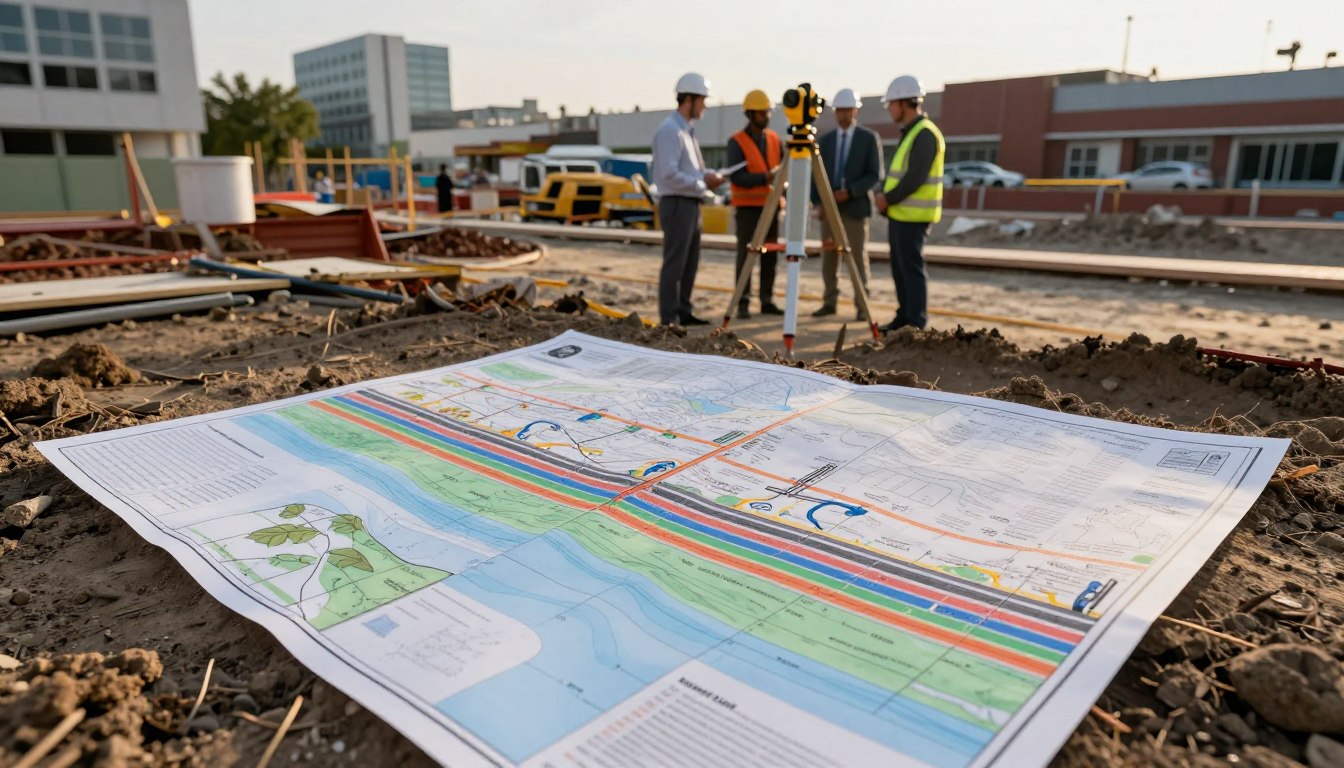
Did you know that thousands of commercial construction projects face delays every year? This is because of hidden underground utilities that aren’t found until it’s too late. These issues can cause big problems, like project cancellations and safety risks.
subsurface utility mapping
If you’re managing a project, knowing about these risks is key. Utility locating technology has improved a lot. It helps find potential problems early, saving you from big surprises and keeping your project on schedule.
Key Takeaways
- Hidden underground utilities pose significant risks to commercial construction projects.
- Subsurface utility mapping can help identify potential hazards.
- Advanced utility locating technology can mitigate risks and prevent costly delays.
- Understanding these risks is crucial for project managers and stakeholders.
- Early identification of potential hazards can save time and money.
Why Hidden Infrastructure Is a Growing Construction Risk
Construction projects are getting more complex. This means the risks from hidden infrastructure are growing fast. Knowing what’s hidden is key to a project’s success.
What Traditional Utility Marking Does Not Reveal
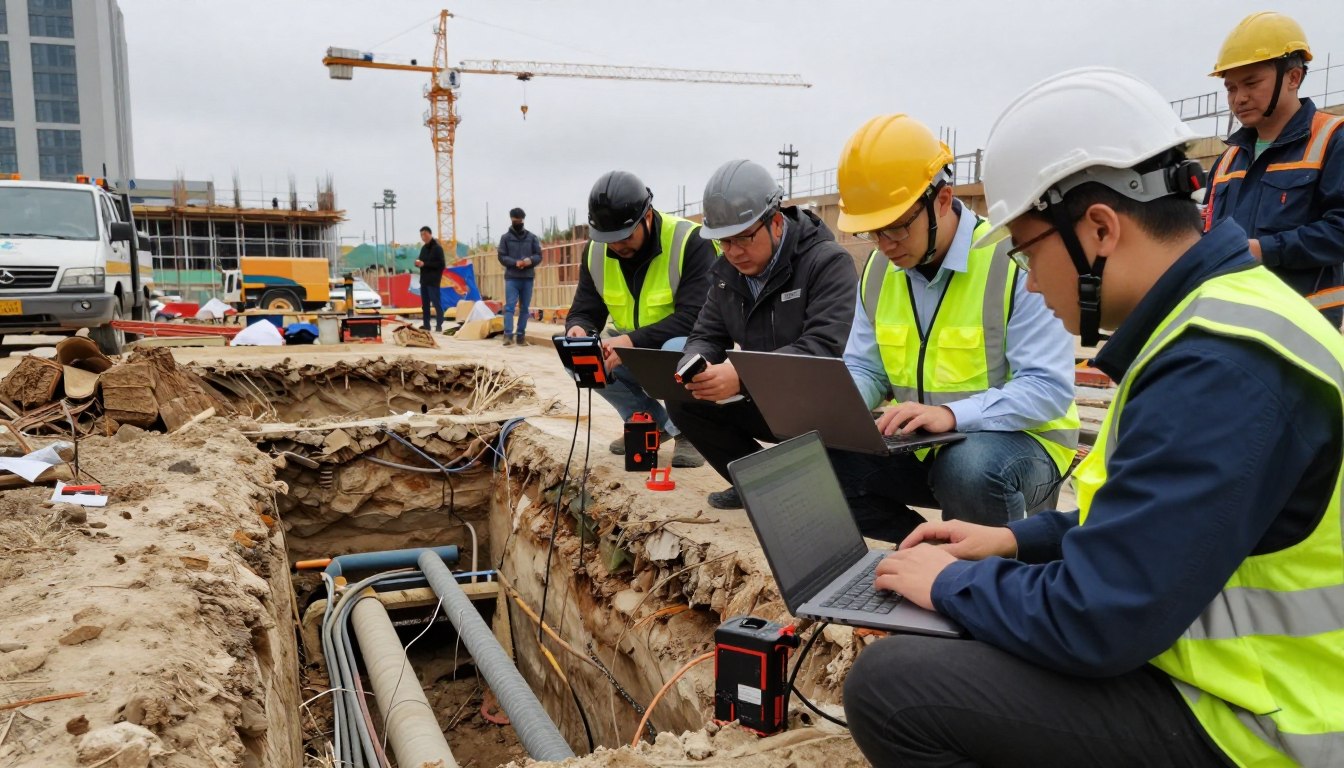
Traditional utility marking often provides only a partial view of what’s actually beneath a jobsite. Public marking services typically focus on municipally owned lines, leaving privately owned infrastructure frequently undetected. That hidden layer can include irrigation systems, parking lot and site lighting, fuel or propane storage tanks, and secondary electrical and communication lines that never appear on standard records.
This gap creates real risk during excavation and site work. That’s why solutions like GPR scanning in Austin are increasingly used to supplement traditional marking. By combining advanced electromagnetic locating tools with ground-penetrating radar, technicians can map concealed infrastructure with far greater accuracy, helping teams avoid accidental strikes, service disruptions, liability exposure, and costly construction delays.
Privately Owned Underground Systems as a Liability Factor
Privately owned systems can be a big problem in construction. They might not be listed in public records. This makes it hard to find them using old methods. It can cause delays and safety risks.
How Early Detection Supports Safer Project Sequencing
Finding hidden infrastructure early is key to safer projects. Advanced underground services detection technologies help spot risks early. This way, you can plan your project better, avoiding delays and accidents.
Locating buried utilities well is part of early detection. Using the right tools and methods makes construction safer and more efficient.
Identifying Hidden Underground Utilities Before Breaking Ground
Before you start digging, it’s crucial to find hidden underground utilities. Modern infrastructure is complex, hiding many underground systems. This makes it hard to navigate construction sites safely.
Legacy infrastructure and abandoned systems are big risks. Many cities have old infrastructure that’s been replaced but still exists. Experts say “The presence of legacy infrastructure can significantly complicate the process of identifying current utility lines.” Understanding the importance of locating underground is key for project success.
Legacy Infrastructure and Abandoned Systems
Legacy infrastructure is old utility systems installed decades ago. They might still work or be abandoned, but still there. The challenge is to find and map these systems to avoid damage during construction.
Abandoned systems are tricky because they might not be on current maps. Construction teams often find unexpected utilities that have been unused for years.
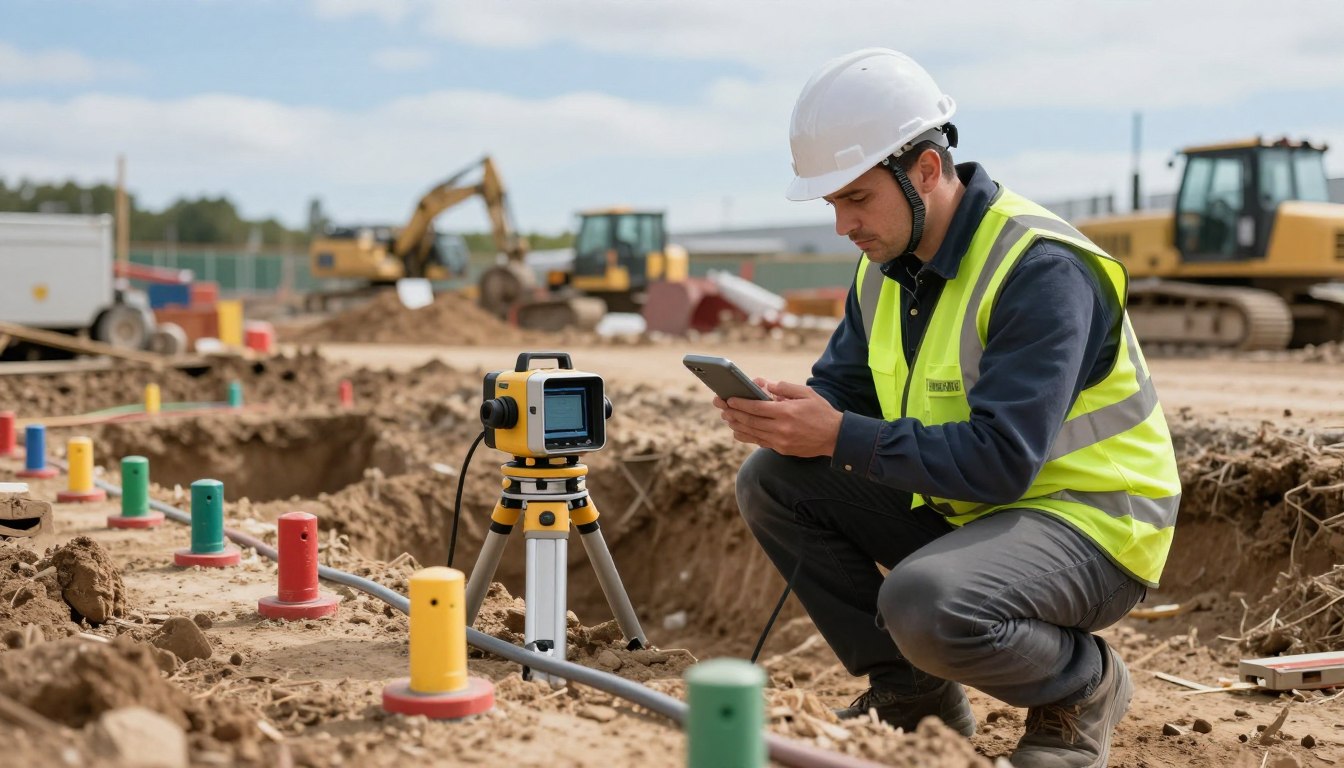
underground utility surveying
Private Utility Lines Missing from Public Records
Private utility lines, like those for buildings or companies, are often not in public records. These lines can be dangerous because they’re not marked or documented, making them hard to find.
To lower this risk, talk to property owners and local utility companies. Get as much info as you can about private lines on your site.
Recently Installed Systems with Incomplete Documentation
The role of integrated software in reducing construction project risks is undeniable; however, new utility systems can also be risky if their records are wrong or missing. This can happen due to poor communication among contractors, utility companies, and project managers.
To fix this, ensure all new systems are well-documented. Share this info with everyone involved. Using a utility mapping service can help keep records accurate.
By understanding these challenges and taking steps to identify hidden utilities, you can reduce project risks. Using subsurface utility engineering can give you a clear view of what’s underground. This helps you move through complex infrastructure safely.
How to Select the Right Detection Technology for Your Project
Choosing the right technology to find hidden underground utilities is key for your project’s success. There are many methods, each with its own strengths and weaknesses. Knowing these can help you make a smart choice.
Ground Penetrating Radar (GPR) Applications
Ground Penetrating Radar (GPR) is a non-destructive way to see what’s under the ground. It uses radar pulses to create images of the subsurface. GPR can find both metal and non-metal objects, making it a great tool for finding utilities.
GPR is good for:
- Finding underground utilities in crowded areas
- Finding empty spaces under the ground
- Locating pipes and cables that aren’t metal
Electromagnetic Locating Tools and Their Limitations
Electromagnetic tools are common for finding underground utilities. They send an electromagnetic signal through conductors like metal pipes. But, they struggle with non-metal objects.
The main issues are:
- Hard to find non-metal utilities
- Can get confused by other electromagnetic signals
- Needs a conductive target to work
When to Use Vacuum Excavation for Visual Confirmation
Vacuum excavation is a safe way to see if utilities are really there. It uses a vacuum truck to dig up soil without harming the utility.
It’s best when:
- You need to know exactly where something is
- There are many utilities in the area
- You want to check if other methods were right
Integrating 3D Mapping with Building Information Modeling
Using 3D mapping with Building Information Modeling (BIM) makes finding utilities more accurate. It combines subsurface mapping with BIM to create a detailed digital model of your project.
The benefits are:
- Better at finding and solving conflicts
- Shows underground utilities clearly
- Helps everyone involved work together better
By picking the right technology and using advanced modeling, you can lower risks from hidden utilities in your projects.
Step-by-Step Process to Mitigate Hidden Infrastructure Risks
To manage hidden infrastructure risks, you need to understand the steps involved. A systematic approach can help reduce unexpected underground infrastructure issues during construction.
Conducting a Thorough Pre-Construction Site Assessment
The first step is a detailed site assessment before construction starts. You should gather all site information, including utility records and surveys. Using utility mapping services helps understand underground utilities.
Identify hidden infrastructure risks like abandoned utilities and private lines. Knowing these risks helps plan better.
Developing a Comprehensive Utility Survey Plan
After understanding the site’s risks, create a utility survey plan. This plan outlines how you’ll detect and map utilities. Ground penetrating radar (GPR) and electromagnetic tools are common methods.
Consider your site’s conditions, like soil type and utility depth, in your plan. This makes your detection efforts more effective.
Implementing Proper Detection Protocols
With your plan ready, start detecting utilities. Use the chosen technologies and methods. It’s important to follow best practices for underground utility detection.
Verify your findings with multiple methods or technologies. For example, use both GPR and electromagnetic locating.
Creating Effective Documentation and Communication Strategies
Effective documentation and communication are key. Keep detailed records of your detection efforts. Clear communication among stakeholders is also crucial. It ensures everyone knows the risks and mitigation steps.
By following these steps and being proactive, you can avoid costly delays. This ensures your construction project’s success.
Real-World Case Studies: When Hidden Utilities Derailed Projects
Construction projects often face risks from hidden underground utilities. These risks can cause delays and financial losses. We’ll look at real cases and how to avoid these problems.
The $2 Million Downtown Office Complex Disaster
A downtown office project hit a snag when crews found an undocumented underground utility line. The line wasn’t on any maps, causing a big delay. This led to over $2 million in extra costs for repairs and delays.
This shows how crucial subsurface utility engineering is in avoiding such disasters.
Six-Month Hospital Expansion Project Delay
A hospital expansion project was delayed when hidden underground utilities were found. The utilities weren’t in the records, forcing a temporary stop. This delay pushed the project’s end date back by six months.
This highlights the need for good underground utility surveying to avoid such delays.
- The discovery of hidden utilities led to a significant delay.
- The project timeline was extended by six months.
- The importance of accurate utility mapping was underscored.
Lessons Learned from Successful Risk Mitigation
Despite the challenges, some projects have successfully managed risks from hidden utilities. Key strategies include:
- Doing thorough pre-construction surveys to find utility locations.
- Using advanced tech like Ground Penetrating Radar (GPR) for accurate detection.
- Having a detailed utility management plan to handle risks.
By learning from these examples and using best practices in subsurface utility engineering and underground utility surveying, projects can lower risks. It’s vital for project managers to focus on utility detection and management for project success.
Conclusion: Protecting Your Construction Projects from Hidden Infrastructure Surprises
To keep your construction projects safe from hidden surprises, you need to act early and use the latest detection tools. Knowing the dangers of hidden underground utilities helps you keep your project safe and successful.
Using underground utility detection and mapping services is key. They help find hidden dangers before they cause big problems. This way, you avoid costly delays and follow all rules.
By using the latest detection tools and following the best practices, you can lower the risk of hitting hidden utilities. This makes your project run smoothly. It also keeps everyone involved safe.
Choosing reliable utility mapping services and being proactive about underground utilities will help your projects succeed. It’s a smart move for your project’s future.