Key Takeaways
- SASE integrates networking and security into a unified, cloud-native service.
- It enhances security for remote workforces and cloud applications.
- Implementing SASE can lead to improved performance and reduced costs.
As organizations adapt to rapid digital transformation, the need for robust, unified network security solutions has grown stronger than ever. Traditional, perimeter-based models fail to address the complexities of remote work, cloud adoption, and ever-evolving cyber threats. These shifts have sparked a surge in interest around Secure Access Service Edge (SASE), a cutting-edge framework that tightly integrates networking and security in a cloud-native fashion. For companies assessing their options, comparing the best SASE vendors for secure access is a crucial first step in building a more resilient and scalable IT strategy.
SASE’s relevance is further amplified by the accelerating adoption of remote work and the demand for seamless, secure application access, regardless of where users connect. By unifying disparate security and networking functions, SASE minimizes complexity, eliminates performance bottlenecks, and provides consistent, elevated protection in a perimeterless enterprise. As security leaders explore how to future-proof their infrastructure, SASE stands out as a transformative enabler for secure digital growth.
Business continuity and operational agility depend on the ability to securely connect people, devices, and data wherever business activities occur. SASE empowers organizations to enforce granular security controls, support zero-trust architectures, and respond quickly to emerging cyber risk—all without sacrificing speed or user experience. As the network perimeter evolves, so too must security strategies, making SASE a central pillar of forward-looking security roadmaps.
As SASE continues to gain traction, industry leaders and analysts see it as the blueprint for converged, software-driven security built for the cloud era. Taking steps to understand—and implement—SASE is critical for businesses looking to compete in an increasingly unpredictable threat landscape and a hybrid work environment.
Understanding SASE
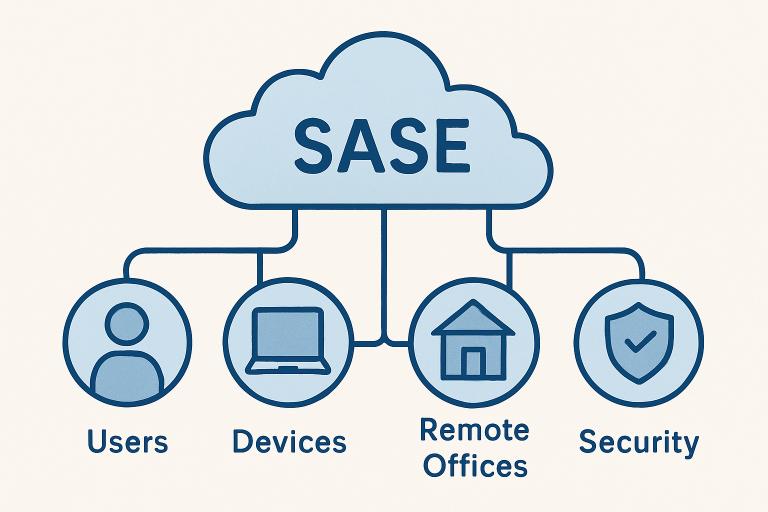
SASE, or Secure Access Service Edge, describes the convergence of wide-area networking (WAN) and comprehensive security services—including secure web gateway (SWG), firewall as a service (FWaaS), cloud access security broker (CASB), and zero-trust network access (ZTNA)—within a single, cloud-delivered platform. Instead of relying on a static, location-based perimeter, SASE enforces policies closer to the end user or device, wherever they are, bringing agility, adaptability, and consistency to security operations.
Delivered via distributed cloud infrastructure, SASE assures that traffic from branch offices, remote employees, and third-party partners is protected and optimized, regardless of physical location. This model mitigates the risks associated with legacy castle-and-moat approaches, creating a dynamic perimeter based on identity, real-time context, and continuous risk assessment. As highlighted by Gartner, SASE is poised to transform both the architecture and consumption of network security services.
By integrating networking and security into a single framework, organizations can simplify their operations, reduce costs, and respond more quickly to evolving threats. Over time, SASE adoption enables more resilient, scalable, and user-centric IT environments that align with the modern demands of business and the workforce.
Benefits of SASE
The business case for SASE is compelling:
- Enhanced Security: By fusing advanced security services directly into the network fabric, SASE delivers end-to-end threat prevention, data loss protection, and real-time traffic inspection—regardless of user location.
- Improved Performance: Cloud-native deployment enables SASE solutions to dynamically route and optimize traffic, thereby significantly reducing latency and enhancing access to applications and services.
- Cost Efficiency: Consolidating networking and security reduces operational overhead, uncouples organizations from legacy hardware, and streamlines vendor management and policy enforcement.
This unified approach to network security also facilitates easier support for regulatory compliance initiatives and the enforcement of consistent security standards across globally distributed environments.
Implementing SASE in Your Organization
Transitioning to a SASE framework should be structured and strategic:
- Assess Current Infrastructure: Begin by mapping existing network assets, security tools, and connectivity needs. Identify gaps, redundancies, and areas where legacy solutions are falling short.
- Select the Right Vendor: Assess SASE platforms by evaluating their scalability, security features, geographic coverage, platform integration, and service reliability. The needs of your workforce, data privacy requirements, and application ecosystem should determine your selection criteria.
- Develop a Migration Plan: Chart a phased migration, rolling out components in a way that minimizes disruption. Prioritize critical applications and users first. Training IT and security staff, as well as maintaining clear communication with the business, can smooth the adoption process and expedite user buy-in.
It’s essential to collaborate with vendors that provide comprehensive documentation, seamless migration support, and ongoing technical guidance to fully leverage the benefits of SASE.
Real-World Examples of SASE Adoption
Organizations across industries are rapidly adopting SASE architectures to enhance resilience and streamline network management. Enterprises are increasingly deploying enterprise-grade SASE solutions that demonstrate the approach’s scalability and adaptability for organizations of all sizes. These deployments leverage unified platforms to securely connect, monitor, and manage networks as companies expand their digital footprints.
Global enterprises, healthcare providers, and financial institutions report improved performance, simplified management, and centralized security policy enforcement as key benefits driving the adoption of SASE. The architecture has proven particularly valuable in environments where secure, reliable remote access and seamless cloud integration are essential.
Challenges and Considerations
- Integration Complexity: Integrating SASE with deeply entrenched legacy IT systems can require significant time, expertise, and budget.
- Vendor Selection: With a crowded SASE market, functionality and service levels vary widely—making thorough evaluation and pilot testing crucial.
- Training and Adaptation: Adopting a new operating model requires upskilling security teams and ensuring that the broader organization understands the new protocols and processes.
Addressing these hurdles up front, with a focus on clear business objectives and user needs, can streamline deployment and optimize the value delivered by your SASE solution.
Conclusion
As the cyber threat landscape becomes increasingly complex, implementing a SASE-based architecture provides organizations with a scalable, efficient, and future-ready approach to network security. SASE’s consolidated, cloud-native model enables unified policy enforcement, superior protection, and optimal performance—regardless of how or where employees connect. Companies that strategically adopt SASE will be better positioned to safeguard their assets, enhance business agility, and drive secure digital transformation in a perimeterless world.