Key Takeaways
- Playful activities like puzzles and board games significantly improve children’s math and spatial skills, strengthening both foundational understanding and higher-order thinking abilities.
- Incorporating play into math education fosters engagement, making children more receptive to complex and abstract concepts, and enhances their problem-solving abilities.
- Early exposure to math through play lays a strong foundation for future academic success, promoting a positive attitude and greater self-confidence in tackling new learning challenges.
Mathematics forms the backbone of critical and analytical thinking, empowering children to tackle everyday challenges and future academic pursuits. The importance of math in the development of logical reasoning and problem-solving skills cannot be overstated, as these abilities influence success across all areas of life, from schoolwork to daily decision-making. Making math fun and approachable is essential for fostering a lifelong appreciation of the subject. Traditional methods often focus on memorization and drills, which can cause anxiety and limit creativity. In contrast, engaging young minds through playful activities, such as math-based games, puzzles, and hands-on experiences, not only makes math more enjoyable but also fosters greater retention and mastery of concepts. Explore how play-centric approaches, from puzzles to board games, create a solid foundation for lifelong learning and academic growth. For a curated selection of educational games that promote math skills, visit https://simplyfun.com/collections/math-stem-games.
When children engage with mathematical concepts through play, their enthusiasm and problem-solving ability significantly improve. They move beyond seeing math as isolated rules, instead fostering a sense of ownership in learning by applying reasoning skills in innovative ways. Research indicates that activities such as puzzles and collaborative games forge connections between mathematical logic and real-world scenarios, transforming playful engagement into a pivotal process that builds confidence in tackling math tasks. These rich experiences promote persistence, flexible thinking, and intrinsic motivation, serving as strong predictors of later success in STEM fields, where such skills are increasingly vital.
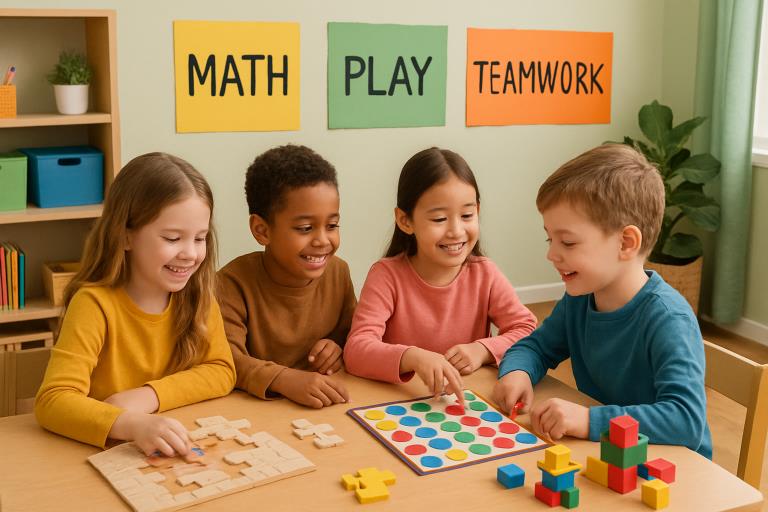
In addition to enjoyment, these playful math activities impart essential social skills, including teamwork, communication, and perseverance. Collaborative games encourage children to listen to others, articulate their thoughts, and adjust their problem-solving strategies. Engaging in friendly challenges inspires them to question, reason, and persist through difficulties, all of which are critical for academic success and lifelong learning. The development of resilience through persistence ensures a proactive attitude towards math. Whether through teamwork in puzzles or competition in board games, these capabilities are applicable across various life areas.
Incorporating play into learning does not require specialized environments or costly resources. Common household activities like cooking, shopping, or tidying can seamlessly integrate math skills into a child’s daily routine. By turning these experiences into interactive lessons, parents and educators can nurture children’s curiosity about numbers, patterns, and measurements. For instance, meal preparation provides a platform for exploring fractions and sequencing, while shopping allows practice in counting and estimating costs. With thoughtful intent and creativity, these moments can become enjoyable, engaging learning experiences that help children perceive math as both relevant and accessible.
The Role of Play in Math Education
Play acts as a natural vehicle for learning, especially among young children. It’s through play that children often make sense of the world, experiment with laws and rules, and develop essential cognitive skills. By weaving mathematical concepts into playful scenarios, children gain a practical grasp of mathematics without the pressure commonly associated with rote learning. In fact, playful learning allows children to approach mathematical challenges without the fear of failure, making mistakes a valuable part of the process. The playful environment encourages risk-taking and experimentation while minimizing anxiety and resistance to challenging concepts. As children explore new ideas through storytelling, construction, or pretend play, they are motivated to revisit and refine their understanding. According to Edutopia, students actively engaged in playful math experiences show higher levels of motivation and deeper conceptual understanding. This translates to more lasting knowledge retention and an excitement for learning that persists beyond the classroom.
Puzzles: Enhancing Spatial and Mathematical Abilities
Puzzles are renowned for nurturing a range of skills essential in math and STEM disciplines. When children manipulate puzzle pieces, they develop a keen eye for patterns, shapes, and relationships—skills directly applicable to geometry and algebra later in life. Research from the University of Chicago reveals that children who regularly engage in puzzles between the ages of two and four develop superior spatial skills, such as mental rotation and visualization. These skills directly influence performance in mathematical reasoning and future STEM coursework. Puzzle play is not only intellectually stimulating but also promotes perseverance, concentration, and the ability to break down complex problems into manageable steps.
Board Games: Boosting Numerical Skills
Games like Chutes and Ladders, Monopoly, and other number-based activities provide invaluable practice with core math concepts in a social, engaging context. Rolling dice, moving pieces, and keeping track of scores all reinforce numerical fluency and help solidify essential operations such as counting, addition, and subtraction. Extensive research over the past two decades confirms that such games allow young learners to develop better counting, addition, and even numerical value recognition. Classic board games promote mathematical fluency and confidence by transforming learning into a cooperative, low-stakes experience. As children progress to more complex games, they develop deductive reasoning, a sense of probability, and even simple algebraic thinking without even realizing it.
LEGO and Block Play: Building Math and Spatial Skills
Incorporating LEGO and block-based activities into daily routines provides robust opportunities for children to construct, deconstruct, and visualize abstract concepts. Stacking and connecting pieces require children to think ahead, plan, and execute ideas—skills that mirror mathematical modeling and problem-solving. A 2025 study highlighted that teacher-led LEGO programs yield impressive gains in mathematics and spatial reasoning, demonstrating that hands-on play can have long-term academic benefits. These activities challenge children to identify patterns, measure distances, understand symmetry, and solve spatial problems. Hands-on experiences with blocks and LEGOs thus support creative problem-solving, pattern recognition, and three-dimensional thinking—fundamental abilities in higher-level mathematics. More on these findings can be found at LEGO can improve math and spatial ability in elementary students, which details the direct link between block play and enhanced learning outcomes.
Integrating Play into Everyday Learning
Turning ordinary moments into math-rich experiences doesn’t require elaborate setups or special tools. With a little creativity, almost any daily routine or family activity can become a learning opportunity. The following strategies can be seamlessly woven into daily life to help children build math skills while having fun:
- Counting and Sorting:Engage children in sorting socks, toys, or utensils, and have them practice grouping and counting their collections, reinforcing their ability to classify and compare objects.
- Measurement and Estimation:Invite children to help measure ingredients in recipes or compare objects found at home for hands-on math practice. You can also encourage children to estimate quantities, measure lengths, or keep track of time in meaningful contexts.
- Shape Recognition:Take “shape hunts” around the house or neighborhood, identifying triangles in signs or circles in wheels to enhance geometric awareness in everyday settings. Finding patterns, symmetry, and angles in familiar objects helps reinforce key math concepts beyond worksheets and textbooks.
Conclusion
Embedding mathematics in playful exploration transforms learning into a lifelong habit rather than a fleeting classroom activity. Whether through puzzles, board games, or interactive block play, children gain not only essential skills but also the confidence and curiosity necessary for future achievement. The most effective math experiences are those that cultivate enjoyment, perseverance, and a genuine love of discovery—qualities that serve children well throughout life. Integrating play into math education enriches children’s lives today. It paves the way for a future shaped by critical thinking and discovery, ensuring that the next generation grows up equipped for both academic success and real-world problem solving.