The Turning Point for Commercial Comfort
Commercial spaces sit at the crossroads of comfort, cost, and climate responsibility. For decades, heating and cooling systems did the job—reliably, often relentlessly—at the expense of energy budgets and carbon goals. Now, with utility rates rising and sustainability moving from buzzword to business imperative, the HVAC room has become a stage for innovation. The modern playbook blends efficient hardware, intelligent controls, renewable energy, and a holistic approach to building design. The result: systems that heat and cool with precision, use less energy, and make indoor environments healthier and more resilient.
Smart Controls: The Brain of Modern HVAC
HVAC has become a data-driven, responsive machine thanks to smart technology. Occupancy sensors, networked thermostats, and BAS literally read the room, altering temperature, ventilation, and humidity based on headcount, weather, and time of day. Demand-controlled ventilation reduces airflow in vacant places. Predictive algorithms reduce waste and peaking. Facility teams may pilot energy management with real-time insight and trend monitoring using dashboards.
Electrification and Heat Pumps Go Big
Electrification changes commercial heating rules. Air-source and water-source heat pumps, including VRF systems, are supplying heat and cooling from the same equipment while reducing fossil fuel use. Cold-climate heat pumps and dual-fuel solutions maintain performance in mild to cold regions. Heat recovery chillers recycle cooling waste heat for hot water or space heating in an elegant, circular application that turns “waste” into a service.
Powering HVAC with Renewables
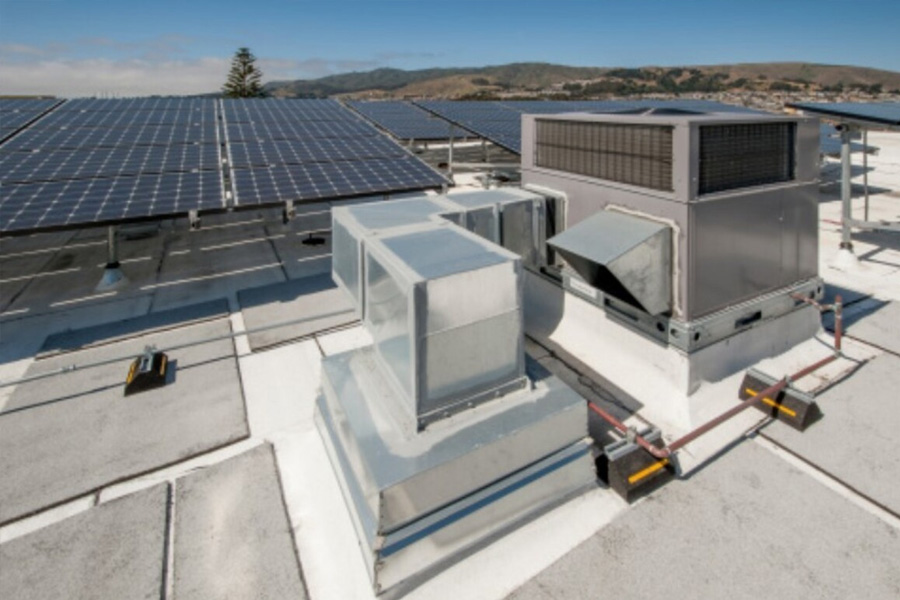
Savings multiply with electric HVAC and on-site renewables. Geothermal systems use consistent subterranean temperatures for year-round conditioning, while solar arrays can bear some HVAC loads during peak daylight hours. Microgrids with battery storage reduce demand peaks, keep essential spaces pleasant during outages, and increase cost predictability in some buildings. Renewable-integrated HVAC becomes practical as installation costs drop and incentives increase.
Building Envelope: The Unsung Hero
A tight, well-designed enclosure helps an efficient HVAC system. High-performance insulation, smart glazing, shading, and air sealing reduce heat gain and loss, allowing mechanical equipment to be reduced. Thinkful daylighting minimises lighting heat loads, and vestibules and sealed doors save energy. In new construction, envelope decisions set the stage; in retrofits, window film, roof insulation, and duct sealing give immediate victories with big returns.
Indoor Air Quality Meets Efficiency
Air quality is increasingly a key KPI. MERV 13+ filtration, energy recovery ventilators (ERVs), and humidity management offer fresh, energy-efficient indoor environments in modern systems. CO2 sensors adjust ventilation to occupancy. DOAS separate ventilation from heating and cooling, enhancing control and savings. Healthier air boosts productivity and reduces absenteeism, which are just as important as kWh and BTUs.
Thermal Storage, District Energy, and Grid-Friendly Ops
Outside the equipment room, strategy counts. Chilled water tanks or phase-change materials shift cooling loads to off-peak hours and calm demand spikes. Buildings can join district energy networks with high-efficiency central plants for heating and cooling. Grid-interactive efficient buildings pre-cool, pre-heat, or curtail in correlation with energy prices and carbon intensity as utilities reward load flexibility. Comfort choreography is budget- and planet-friendly.
Overcoming Cost and Retrofit Hurdles
Upfront costs can be a speed bump, especially in older buildings with complex constraints. The path forward is pragmatic: start with an audit, prioritize measures by payback, and bundle quick wins with deeper retrofits. Phased upgrades—controls today, envelope improvements next, then major equipment—keep projects achievable. Financing models like energy service agreements, performance contracts, and on-bill financing move capital off the balance sheet. Over the life of the system, lower utility bills, fewer repairs, and reduced risk often outpace initial spend.
Operations, Maintenance, and Measurement
Without attention and verification, sustainability fails. Commissioning and retro-commissioning ensure systems are properly implemented and tuned to reality. Efficiency is maintained by filter changes, coil cleaning, refrigerant checks, and damper calibration. Continuous M&V detects drift before it becomes waste. Facilities can use analytics to make schedule changes, setpoint adjustments, or minor improvements to maintain performance year after year.
What’s Next: AI, Carbon-Neutral Performance, and Design Convergence
The horizon is bright and decidedly smarter. AI will refine setpoints, detect faults, and optimize multi-system coordination across seasons and use cases. All-electric designs will pair heat pumps with renewables, storage, and adaptive controls to approach carbon-neutral operation, especially in high-performance envelopes. Architects, engineers, and HVAC pros will collaborate earlier to weave comfort, health, and energy into one integrated design. Net-zero, low-embodied-carbon materials, radiant systems, and hybrid ventilation will shape a new normal that feels as good as it performs.
FAQ
What’s the fastest way to cut HVAC energy use in a commercial building?
Start with smart controls and scheduling, then tighten the building envelope so equipment doesn’t have to work as hard.
Are heat pumps reliable in cold climates?
Yes—modern cold-climate units and hybrid designs maintain output in freezing weather, often with backup strategies for extreme days.
Do better filters always mean higher energy costs?
Higher-efficiency filters can increase fan load, but right-sizing fans and using variable speed drives often offset the impact.
Is geothermal worth it for small commercial properties?
If the site allows, geothermal can deliver stable, low-cost conditioning over decades, especially when paired with tight envelopes.
How can I improve air quality without spiking my utility bill?
Use demand-controlled ventilation, energy recovery, and proper humidity control to deliver fresh air efficiently.
What is retro-commissioning and why does it matter?
It’s a tune-up for existing systems that aligns controls and equipment with actual building use, often producing quick energy savings.
Can solar really power HVAC meaningfully?
Solar can offset a notable portion of electric HVAC loads, especially during peak cooling hours, reducing demand charges and costs.
Are district energy systems only for big campuses?
They’re most common in large complexes, but smaller districts and shared plants are emerging in mixed-use developments.
How often should smart thermostats be reviewed or updated?
Review schedules and setpoints seasonally and after tenant changes to keep performance aligned with real-world use.
What’s the biggest mistake in HVAC retrofits?
Overlooking the envelope and controls; upgrading equipment without fixing the building’s basics leaves savings on the table.