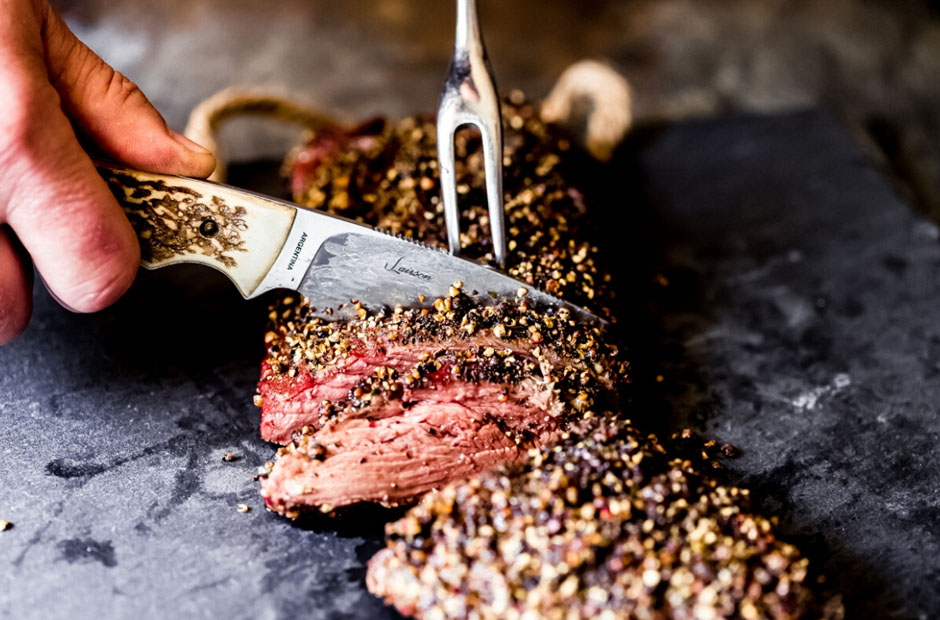
There’s a breakdown in the modern food chain. Industrial agriculture pumps out calories but drains nutrients—your steak might fill you, but leave you starving for iron and B12. Alberta elk flips the script. Grazing stress-free on regenerative land, it creates a unique taste, and nutritional profile. They also possess a more complex, “gamey” flavor compared to the often softer, fattier, and milder taste of confined, grain-fed animals.
1. Stress-Free Muscle: Ecology Dictates Excellence
When an animal is raised within its indigenous ecology, its body chemistry remains “clean,” resulting in a superior culinary asset. That explains why Elk Farms Alberta ecology produces cuts with the best tenderness as a byproduct of farming integrity.
- Cortisol-Free Growth: Elk move freely, graze naturally, and avoid industrial confinement.
- Glycogen Stores: Calm animals store energy in muscles, breaking fibers down naturally for melt-in-your-mouth texture.
- Flavor Born from Freedom: Movement across regenerative pastures builds strength and lean, mineral-rich meat—no additives required.
Tenderloin isn’t tender because a chef waves a knife—it’s tender because the elk lived well. Each stride over well-trampled soil is a rehearsal in muscle perfection. Eating it is participating in that freedom. It’s radical in its simplicity: respect life, and life responds with richness and resilience.
2. The “Well-Trampled” Foundation: Soil as Silent Revolutionary
As the elk move in herding patterns across the Alberta foothills, their weight (up to 700+ lbs per animal) acts as a natural piston. They step on dried seed heads from native grasses and “press” them into the “Deep Cleaned” soil.
- That leads to “Self-Seeding.” It ensures that the most resilient, indigenous plants and best adapted to the Alberta climate—are the ones that regrow. It’s a zero-cost, zero-emission reforestation of the pasture.
- Natural Aeration: Elk hooves smash compacted soil, forging air and water pathways.
- Fertility Surge: When these animals graze, their digestive system process native forage and return it to the earth as manure and urine. This isn’t just waste; it is a Microbial Explosion.
This isn’t subtle; it’s insurgent. The journey creates healthy soil that feeds vegetation, becomes biologically and structurally resilient, enhances mineral density, and becomes part of life’s cycle. When elk feed on that land, their muscles soak up the richness. Every forkful of tenderloin is a taste of a landscape actively reclaiming itself from degradation. Tenderness? It’s the proof that the ecosystem is winning.
3. Traceable Integrity: Connecting Infrastructure to Flavor
A ranch that functions as a high-performance ecological machine, its meat is not just a product, but the “receipt” for a restored landscape.
- Carbon Positive Environment: Solar and ecological infrastructure ensures the ranch operates in harmony with the landscape.
- Full Transparency: Every cut is mapped to herding patterns and soil health metrics.
- Operational Reality: Each tenderloin is a byproduct of a specific acreage that has been “deep cleaned” of toxins and restored to a carbon-positive state.
Hence, when you settle on quality elk meat, you aren’t just eating protein; you are naturally absorbing the strategy and care of the 100% regenerative process.
4. The Absorption Method: Culinary Justice
This is culinary justice phase. Here, aligning your kitchen habits with the ranch’s regenerative cycles, is vital to ensure that none of the “Superfood” density is lost to poor techniques.
- The Deep Clean: Meat tempered to room temperature mirrors the “rinse” of clean systems—no industrial stress survives.
- Toasting: Quick sear locks in minerals and flavor, honoring the sun and soil that nurtured the elk.
- Simmering: Low, slow rest lets juices reabsorb, reflecting the patience of the regenerative cycle.
- Fork Fluff: Slice against the grain to reveal tender, nutrient-dense proof of ecological stewardship.
Cooking this meat is not manipulation—it’s participation. Each step mirrors the ecosystem that raised it. Every bite is a conscious vote for restoration, health, and integrity.
In essence, in a world of diminishing nutritional returns, when you prioritize quality elk cuts, you are effectively buying back your health’s structural integrity and eliminating biological uncertainty while supporting a critical chain of dedicated local producers. However, partnering with a reliable el outlet or ranch isn’t just a “good idea”—it is the crucial leverage point that determines the level of foundational aroma and whether you are getting a superfood or just another anonymous protein.